The Death of the Lamb
Part II
I was nearing the city, thinking of how, with a bit of help from some of my friends, I could probably get my mother to Jerusalem to see Jesus in a few weeks, and how pleased she would be at that thought, when I noticed a loud commotion on the road ahead. A large procession was coming out of the city gate. That tiny little seed of dread, sown so mysteriously in my heart that morning, momentarily forgotten as I mused on lambs and little sisters, now suddenly began to grow again. For I could see that it was a crucifixion procession. The Romans had brought this ghastly method of execution with them when they had occupied Palestine, and more were taking place every day. This man was probably a runaway slave or maybe a thief, and now he was going to die carrying his own cross. But as the procession passed by me, I was suddenly stricken by a paralyzing horror. For a moment I couldn't move, I couldn't think, I couldn't even breathe. This was no rebel Jew, it was Jesus! They were going to crucify Jesus. He was bent nearly double under the weight of the horizontal beam of the cross. His rugged face
was hardly recognizable, swollen and disfigured by countless blows. A cruel circlet of thorns was embedded deep in his scalp and blood streamed from the gashes it inflicted, covering his battered features. His beard had been savagely torn, and his eyes were swollen half closed and glazed with pain and fatigue. His bloodstained garments, evidence of a severe scourging, stuck to his open wounds. As my numbed mind beheld this awful scene, all hope fled, both for the glorious Kingdom promised by the Teacher and for the miraculous healing of my mother.
Even as Jesus passed me, he stumbled in exhaustion and fell, his face in the dust of the road, the heavy crossbeam on top of him. He lay as one dead, except for the heaving of his bruised chest as he fought for air. A horrible silence fell, broken only by the rattling gasps of the Teacher. The centurion in command, seeing that Jesus could no longer go on, quickly scanned the crowd in the road and picked out Simon. I had met Simon that morning and we had walked together toward Jerusalem. He was bringing his own lamb for the sacrifice, too. He was a big man and from the country like me. Also like me, he was enthusiastically awaiting the advent of the new kingdom and had been going to hear Jesus again. He hastily thrust his lamb into my arms as the centurion grabbed him. “I've got it,” I said, now with my arms more than full with two squirming little lambs. Simon was made to pick up the Teacher's beam
and carry it. Jesus was dragged roughly to his feet and made to stagger onward. I abandoned my plans for the Passover celebration in Jerusalem and followed the horrible procession. I almost let my lamb go, but the monetary investment I had made in it stopped me. I hitched up both lambs a little higher under each arm and trudged on. My mind was in a daze. Though the sun still shone, in my eyes the fair day had turned black and I felt cold inside. That seed of dread had bloomed and its deadly flower covered my heart because I knew where we were going. Golgotha, the Hill of the Skull. It was a name that recalled anguish to many whose loved ones or friends had been slain on that loathsome hill. It was the place of death. Everyone knew the name Golgotha. It struck dread into every heart. No one sentenced to death ever came back from there.
Many others also followed this procession, some wailing, some weeping softly, some silent, but all filled with despair. All hopes for the overthrow of the Romans were dashed. Our supposed Messiah was defeated and on his way to ignominious death, and the double column of
legionnaires flanking him ended any thought of rescue.
When we arrived at the hill, we saw that two men already hung writhing in agony on their crosses. I was told later that they were thieves caught red-handed. Simon was released from duty. He put the beam down gently, took a quick, pitying look at Jesus, and came to stand by me. I gave him back his lamb. Both of the lambs were bleating, hungry and afraid. Some of the women of the city hurried toward Jesus and offered with trembling hands the drink of myrrh mixed with wine taken by those about to be crucified. It provided numbing release from the worst of the pain. But strangely, Jesus refused it.
The Roman soldiers detailed to the Crucifixion brutally ripped the Teacher's clothes from his body, tearing flesh and reopening wounds that now again sent forth streams of bright blood down his hideously scourged back. I had to look away at my first sight of his back. It had literally been torn apart. Under the horrifying mass of bloody pulp, I could see the chunks of flesh were missing. As Jesus bent and his skin stretched, I was sure I could see the white gleam of a rib showing.
All watched, appalled, as Jesus was made to lie down on what was left of his back. His arms spread wide over the rugged crossbeam. One of the soldiers knelt on Jesus’ upper arm, pinning it to the beam. He then took a hammer and a large iron nail and deftly placed the point of that nail on Jesus’ arm. He raised his hammer and brought it down with a dull clank, driving that nail through Jesus’ forearm between his two arm bones, just above the wrist. Several of the women gasped. But Jesus, looking straight up into the sky, made no sound. I turned away to hide my eyes, but I couldn't shield my ears from the dull clanks of hammer on nail. Quickly and efficiently, the soldier repeated the process on the other wrist. Suddenly Jesus cried out the first words I had heard him utter. But this was not a scream of agony or a curse against the Romans, he cried, “Father, forgive them, for they don't know what they do!” I was astounded. How could he possibly be forgiving these Romans who were treating him so brutally? They were killing him! The Teacher's actions were beyond me. My mind was filled with sorrow and hatred, and Jesus was not only neither angry nor bitter, but he was sympathetic and forgiving of his tormentors.
The soldiers then helped Jesus to his feet, supporting the weight of the crossbeam on their shoulders for a few moments. They attached a rope to the center of the beam. The other end of the rope was threaded through a pulley on top of a tall post already standing between the crucified thieves, and several of the soldiers took their places on it. As they pulled on the rope, the beam and Jesus began to rise, bumping their way up the post. Blood from his wrists poured out onto the ground. The weight of his body on his outstretched arms immediately caused both of his shoulders to dislocate. I shuddered to think of the excruciating pain he must be experiencing. When the Teacher's feet were two or three feet off the ground, one of the soldiers nailed a short plank to the post between his legs to partially support his body. Several soldiers then lashed the crossbeam to the post, while still others secured the pulley rope to a peg in the ground. The soldier with the hammer stepped forward again then and, bending the Teacher's knees slightly, drove a nail into the post through the heel of each foot. Finally, one of the soldiers mounted the back of the cross and hung on a nail a board on which was written in Aramaic, Hebrew and Greek, “Jesus, the King of the Jews.”
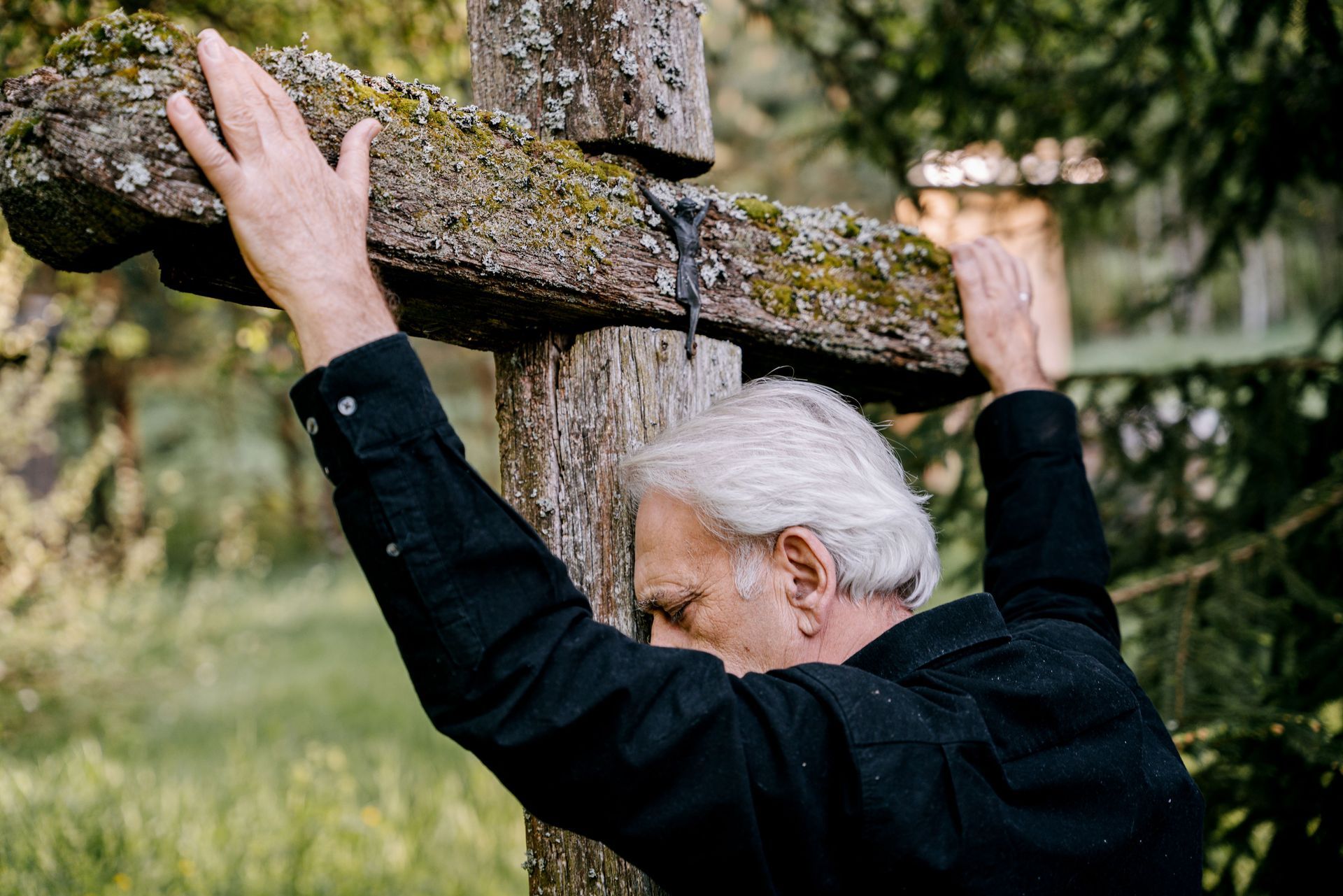
Jesus was crucified. The loving hands that had healed so many, that had miraculously fed the thousands, that had welcomed and blessed the children; the feet that had trod so far over the dusty roads to bring hope to so many - were nailed, bleeding, to the rugged cross. No longer would the Teacher sit on the ground, surrounded by eager ears, and tell of his wonderful kingdom. No longer would he stand before the sick, healing far into the night. And no longer would my mother and I look forward to the day when she and I could walk side by side into Jerusalem, her crippled legs straight and true.
Coarse laughter interrupted my thoughts. The soldiers were distributing the Teacher's bloodstained garments among themselves. Squatting just behind Jesus’ cross, they then drew lots for his robe. It was woven of just one piece of fabric, and the soldiers apparently considered it too valuable to be divided among them. The lot fell to the one who had wielded the hammer. He draped the blood-stained thing over his shoulders and the others bowed low to him in mockery of Jesus. Hatred welled up in me so that, had I a sword close at hand, I might have attacked the filthy Gentiles. And I’d most likely have ended up dead too. I felt Simon's heavy hand on my shoulder. I turned and saw tears in his eyes as he shook his head and said, “It would do no good, my friend.” Finished with their sport, the soldiers went and sat down. Their job was done.
To be concluded
Listen to the audio version
About the author:

Recently retired, Brad looks forward to the challenges of a new ministry. He feels that seniors are a vital part of the church Body and though he has only recently crossed the threshold of “senior-dom,” he trusts that God can use Him to help seniors build a stronger relationship with God and stronger relationships with others. The senior years are accompanied by unique challenges, and Brad hopes to be able to come alongside seniors to pass along God’s hope and encouragement.
Brad and his wife Erin began attending Hannaford in November 2019. They have three grown children and two grandchildren (and a third due Spring 2026).
Recent Posts